

The Reddit GLP-1 Groups Found a New Holy Grail (And this time, it's real)
PHGG: A breakdown of the tasteless, grit-free fiber that won't make you look six months pregnant.

As a food scientist, I spend my days studying the physics and chemistry of what we ea. How ingredients behave in different foods, how they flow, and because I love how food affects our bodies - I also love to learn about how they interact with our bodies.
Lately, I keep seeing PHGG mentioned in all the GLP1 groups and in Reddit, I see it listed in the GLP1 fiber supplements ingredients and ofcourse I would love to talk about it!
If you are new here: My firm belief is that “eat more fiber” was already incomplete advice, now throw GLP1s in the mix and the question is really about how you actually hit those fiber numbers without being able to eat a lot of vegetables. Enter PHGG.
If all the fibers you have tried so far have left you feeling bloated, gassy or just straight up uncomfortable - then PHGG might be the one for you!
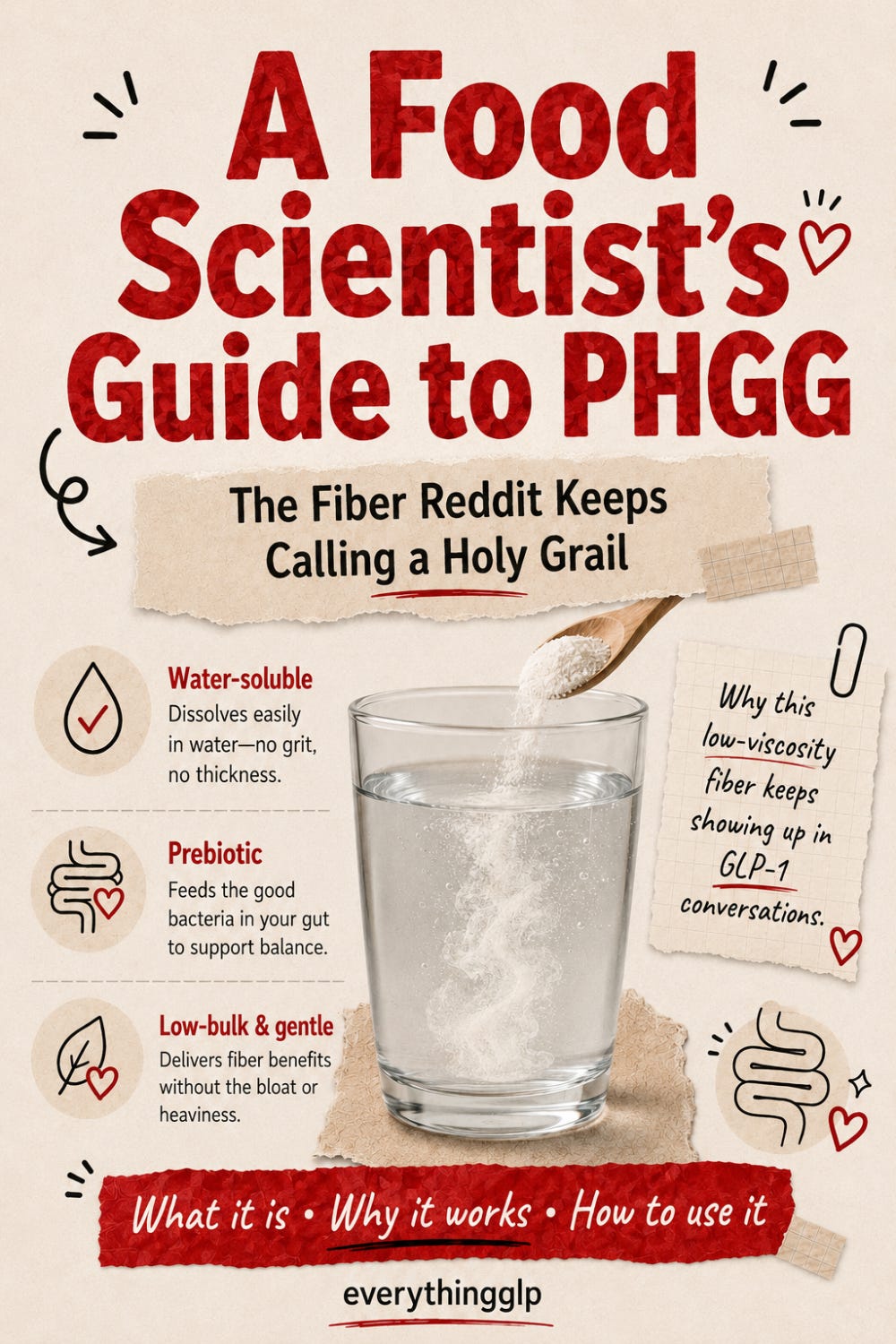
What is PHGG?
PHGG. It stands for Partially Hydrolyzed Guar Gum. It is a natural, water-soluble, prebiotic fiber made from guar gum - which is extracted from guar beans. To make it - they take the long fiber chains in the guar beans and break it down with enzymes to make it easier to dissolve in water and also easier to digest.
What makes PHGG interesting to me is that it has so many practical uses. Some studies find it may help with constipation, while others find it may also help with diarrhea. There is also early research looking at PHGG beyond digestion, including chronic kidney disease, fatty liver, and muscle loss in animal studies. The theory is that some of these benefits may come from PHGG’s effect on the gut barrier and inflammation. In humans, PHGG has also been studied for metabolic health, including blood sugar and lipid metabolism.
As a food scientist, I love PHGG because it is basically an “invisible” fiber. It has almost no texture, no flavor, it’s not gritty, it dissolves (almost) completely in water. Meaning I am able to add fiber to something without any of the mouth feel or flavor issues of the other types of natural fibers. This means that you can add it to things like water, coffee, tea, smoothies, yogurt, soups, or smoothies without changing the texture, or even knowing it’s there.
PHGG works mainly through the large intestine. Since it is a fermentable fiber - it means that your gut bacteria will be able to feed on this fiber and will create short-chain fatty acids - nutrients that your gut bacteria use to thrive and grow, nourish your colon and help keep your gut lining strong.
Why PHGG is Gentler on your digestive system
If you have had problems (like bloating or gas) with fibers found in most fiber supplements, fiber bars, gummies etc they are relying on Inulin or FOS (fructooligosaccharides) to be the main source of fiber.
Inulin and FOS are rapidly fermented by bacteria in the very early part of the large intestine. This sudden, rapid feast causes a sharp spike in gas production. That sudden pocket of gas has nowhere to go, sometimes causing intense & painful bloating.
PHGG behaves differently because of its specific chemical structure. It is a slowly fermentable fiber. Because your gut bacteria break it down gradually, it undergoes a slow, gentle fermentation along the entire length of the colon. Instead of a sudden gas explosion, it is much easier on digestion.
How to add PHGG to your diet
Just because PHGG is gentle, it does not mean that it is impossible to overdo. No one should ever jump from 0 to a full dose of a new fiber. Instead think of it like how you titrate up to a full dose on GLP1s. Start with a small amount and then gradually increase your dose till you are able to have the full amount comfortably.
Week 1: start with 1 gram per day
Mix it into water, coffee, tea, yogurt, or a smoothie. Take it at a time of day when you can observe how your body responds.
Week 2: increase to 2–3 grams per day if tolerated
If there is no increase in bloating, cramping, nausea, or constipation, slowly increase.
Week 3+: consider 3–5 grams per day
Many studies use doses around 3–6 grams per day, depending on the population and symptom being studied. For example, one constipation-related study used 3 and 5 grams per day, while an IBS bloating study used 6 grams per day.
Avoid the stacking trap
One of the biggest mistakes people make is doing too much all at once.
Many people add fiber because they are already constipated. At this time, it is already too late. And then they hit it with everything. They add a fiber supplement, had a tsp of chia seeds, 1 tablespoon of flax seeds, eat a fiber bar, try to chase that down with psyllium husk and then wonder why they feel terrible.
SLOW AND STEADY is the key here.
Start with one thing, slowly add it to your diet, give your body a moment to adjust before you add something else. That way you can know what works for you.
Common mistakes:
Too much fiber too quickly
The wrong fiber type
Not enough fluid
Not enough total food
Too many fiber sources stacked together
Adding fiber before constipation is under control
The key is not to rush.
Fiber works best when the gut has time to adapt.
What not to do
Do not add PHGG on top of every other fiber at once.
A common GLP-1 mistake is stacking too many gut tools in the same day:
PHGG
Chia
Flax
Psyllium
Magnesium
Probiotic
High-fiber bar
Beans
Sugar alcohols
Then the person feels terrible and assumes fiber does not work for them.
A better strategy is to change one variable at a time.
Try PHGG alone for several days before combining it with other fibers. This makes it easier to know what is helping and what is causing symptoms.
The Bottom Line
PHGG is a tool for long-term bowel routine support; it is not a rescue remedy for acute, immediate constipation relief. If your system is completely locked up, adding fiber of any kind will not help until the initial blockage is cleared.
If you are wanting to try it out, I found this one that has PHGG as it’s only ingredient. (No commissions, I haven’t tried it myself, but looks clean label)
Do you have any questions for me? Any new ingredients you want me to research for you? Drop a comment and I will get on it!
As usual - subscribe if you enjoyed this, send to someone who you think would benefit from this!
References:
Kapoor MP, Sugita M, Fukuzawa Y, Okubo T. Impact of partially hydrolyzed guar gum (PHGG) on constipation prevention: a systematic review and meta-analysis. J Funct Foods 2017; 33: 52–66. [Google Scholar]
Polymeros D, Beintaris I, Gaglia A, et al. Partially hydrolyzed guar gum accelerates colonic transit time and improves symptoms in adults with chronic constipation. Dig Dis Sci 2014; 59: 2207–2214. [DOI] [PubMed] [Google Scholar]
Alam NH, Ashraf H, Kamruzzaman M, et al. Efficacy of partially hydrolyzed guar gum (PHGG) supplemented modified oral rehydration solution in the treatment of severely malnourished children with watery diarrhoea: a randomised double-blind controlled trial. J Health Popul Nutr 2015; 34: 3. [DOI] [PMC free article] [PubMed] [Google Scholar]
Rushdi TA, Pichard C, Khater YH. Control of diarrhea by fiber-enriched diet in ICU patients on enteral nutrition: a prospective randomized controlled trial. Clin Nutr 2004; 23: 1344–1352. [DOI] [PubMed] [Google Scholar]
Homann HH, Kemen M, Fuessenich C, Senkal MZV. Reduction in diarrhea incidence by soluble fiber in patients receiving total or supplemental enteral nutrition. J Parenter Enter Nutr 1994; 18: 486–490. [DOI] [PubMed] [Google Scholar]