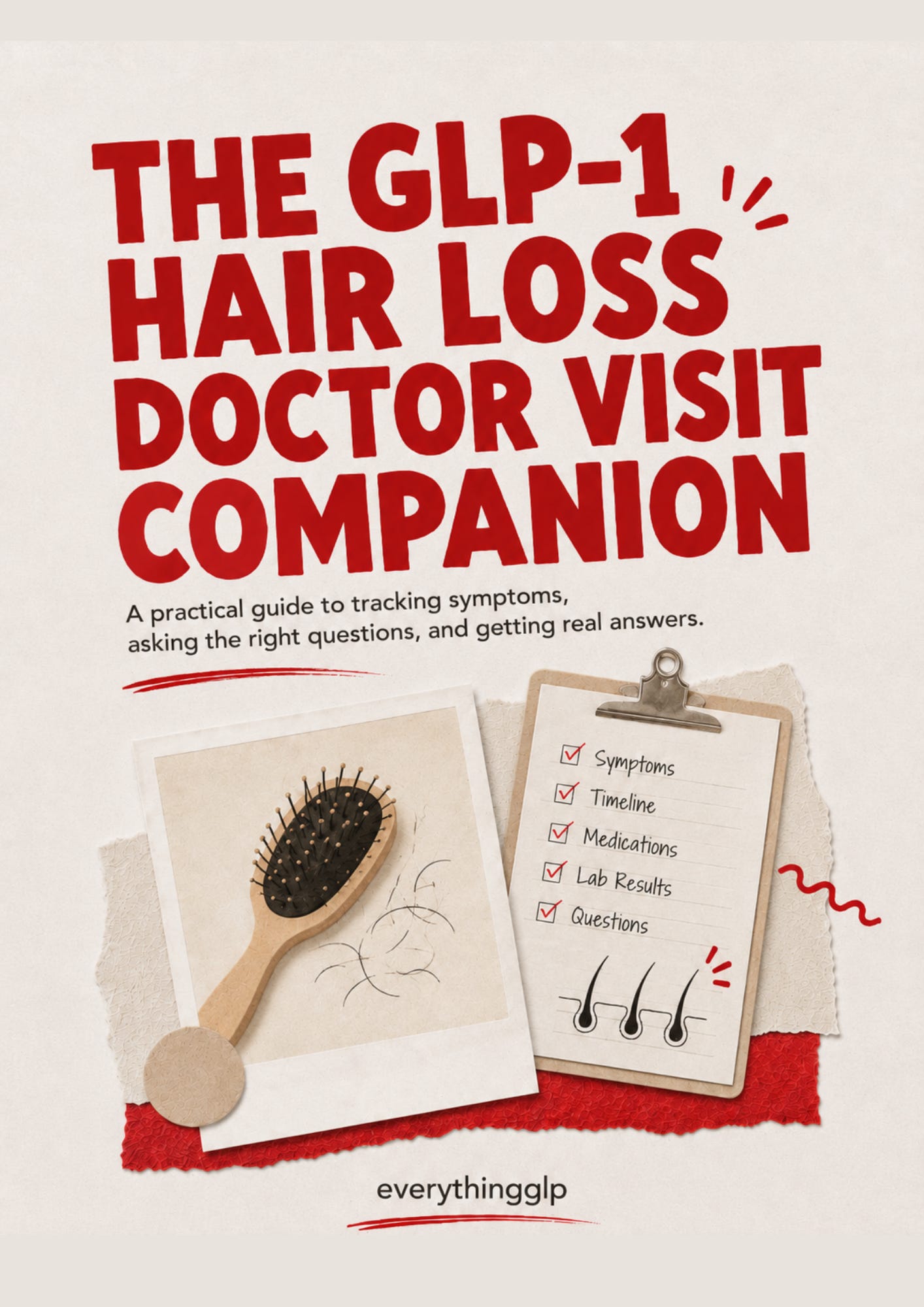
So Your Hairbrush Looks Like a Crime Scene
The GLP-1 Hair Loss Panic Guide: What causes shedding, when to worry, and what to try before spending $88 a month on hair supplements.

You start your GLPs, you are seeing progress and then all of a sudden you are brushing your hair one day and you take a look at your hairbrush. Cue panic. The dreaded hair loss is upon you.
While it is not a direct side effect of the drug, it’s caused indirectly by things like:
Rapid weight loss - shocking the body or nutritional gaps caused by eating less.
While it doesn’t affect everyone, only about 2% of women on GLP1s report experiencing it and men only 1%, it does seem to disproportionally affect menopausal women.
Types of hairloss
Wow was I not prepared for all the different types of hairloss! I was planning on listing all the types but there are so many types - so I am just going to cover the top 3 that are common
Telogen effluvium - this type of hairloss is temporary.
What it looks like: sudden, diffused shedding all over the scalp. More hair in the shower, brush, pillow, or hands.
Most common for GLP1 users
Androgenetic alopecia / female pattern hair loss
GLP-1s may not cause this type, but weight loss-related shedding can unmask it.
What it looks like: gradual thinning, usually at the part line, crown, or temples. In women, the part often gets wider, but the front hairline may stay mostly intact.
Common causes: Genetics, Androgen sensitivity, PCOS or hormonal imbalance in some people, Perimenopause/menopause shifts
Nutritional Deficiency related shedding
This overlaps with telogen effluvium, but it is worth separating because the fix is different.
Common nutrient issues to check: Protein intake, Ferritin/iron, Vitamin D, B12, especially if vegetarian, Zinc, Folate
Why hairloss?
Basically it’s your body’s flight response. I learned that at any given time, about 90% of your hair follicles are in active growth phase and 10% are in resting phase ((telogen). When you have rapid weight loss - your body goes into survival mode and puts a lot of your active hair follicles in resting mode - which means 2-3 months later, you will start to see your hair falling out and thinning.
The good news is that:
It is usually temporary
More good news:
In 3-6 months after the hairloss stabilizes, you should see noticeable hair growth.
Anyway - I 100% understand how scary it is and researched all the possible things you can do to prevent as best as you can, how to support your body your hair back on track and also what to do when you are waiting - if your hair feels thinner and you need a quick fix. Let’s dive in.
Redflags:
If your hair is coming out in circular patches or your scalp is very red, itchy or inflamed - go to your doctor right away. You may be having an allergic reaction or an auto-immuno response to the drug.
First 3 steps if you notice hair shedding on GLP-1s:
Track your timeline: When did you start GLP-1s? When did weight loss speed up? When did shedding begin?
Check the basics: Protein intake, calories. Are you getting enough micronutrients? Iron?
Look at the pattern: Diffuse shedding is more likely telogen effluvium; patches, redness, itching, or pain need medical attention.
I found 4 main categories of things you can do if you start noticing hair loss:
Talk with your doctor
Tell them what you are experiencing and get to the root cause. They can also help you run some labs and find out if you are deficient in iron or vitamin D which directly impact hairloss.
For them to be able to help you differentiate between “this is just shock” and “maybe you might have a deficiency” - go to your doctor with DATA.
(I have attached a document of the information to collect and how to present your information to your doctor so they can actually help you for my paid subscribers below)
Supplements
Since some of the hairloss can be caused by nutritional deficiencies in vitamins and minerals like zinc, vitamin D, and B-vitamins - and also other things like protein - it makes sense that a good supplement can help your hair grow back.
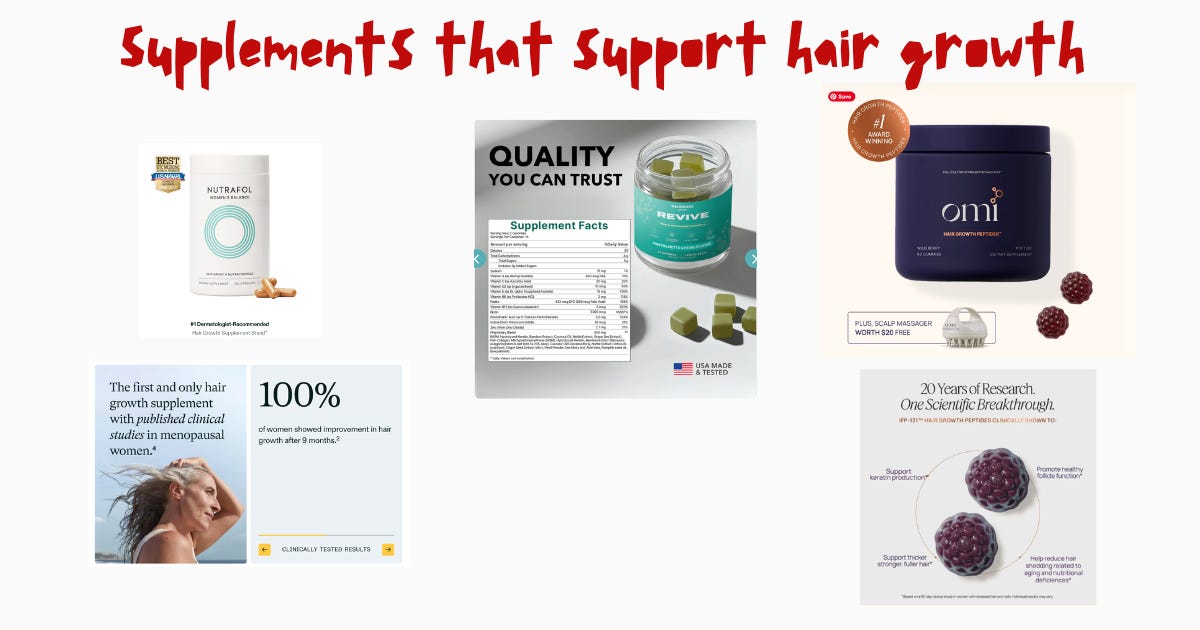
I found a bunch of options from things that are natural, lots that have been studied and proven - but wow were they pricey! I just want to say these companies have their marketing DIALED IN. They know exactly what to say to get you to hit that buy button. But oh gosh are they pricey!
With Nutrafol at $88 for a one month supply ($66 if you subscribe) and Omi at $86+shipping, I was wondering what is the best way to approach supplementation?
I dug deeper and found that: The American Academy of Dermatology says that taking hair supplements blindly can backfire, because too much of certain nutrients can worsen hair loss.
My favorite approach: Check with my doctor, get to labs to understand the root cause and supplement only what is deficient. If that’s not possible, I would try with a multivitamin that contains: Iron, vitamins A, B-complex, C, D &E, Zinc, Omega 3. And see if I can get micronutrients like selenium from dietary changes. And (I know you’ve heard it) I would also focus on getting more protein.
Some things to be careful about:
Biotin:
Biotin is massively over-marketed for hairloss. True, a biotin deficiency can cause hair loss, but it is uncommon. This NIH paper says evidence for biotin for hair/skin/nails is limited mostly to case reports and small studies.
Also important: biotin can interfere with lab tests, including thyroid and heart-related tests. Tell your doctor if you take it.
Collagen:
Collagen may support protein intake and provide amino acids like glycine and proline, but it is not a complete protein. If you rely on this without getting the rest of the essential amino acids - it will not help you.
Topical Treatments
Wow was this a rabbit hole to fall into.
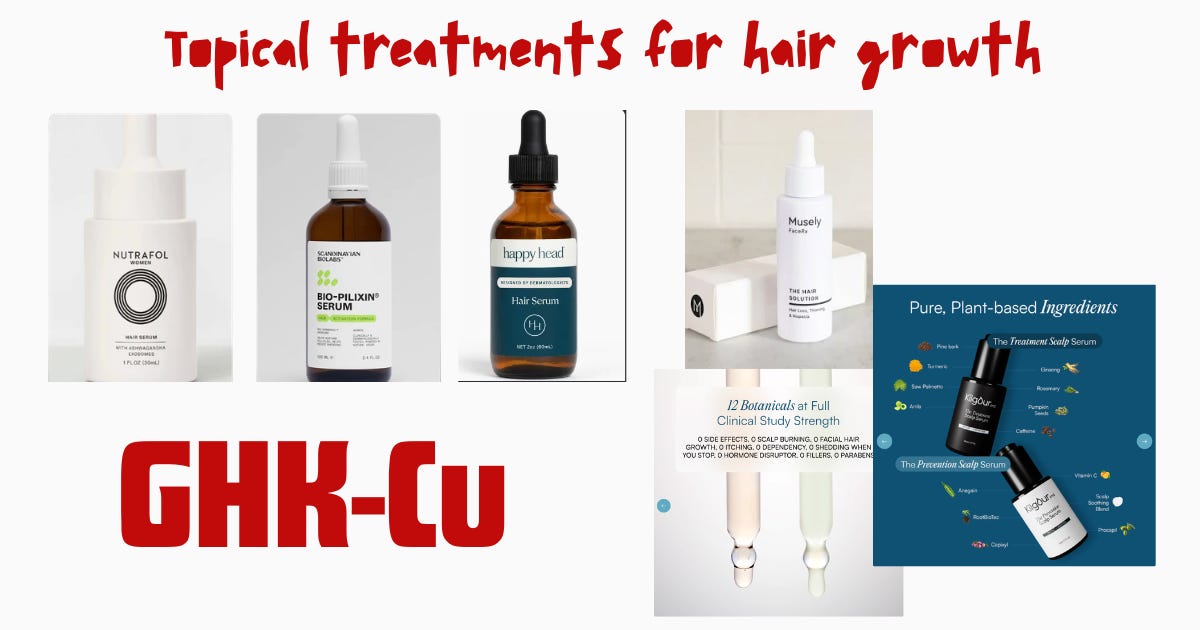
From plant extracts, to peptides and chemical concoctions - there were so many options that it was totally overwhelming. Do they work? Maybe.
Currently, there are only two drugs that have been FDA approved for treating hair loss and only one that is topical:
Topical minoxidil, now available over the counter in 2% and 5% solutions and 5% foam, is approved for use in both men and women. I couldn’t find anywhere that explained the exact mechanism of action of minoxidil - but what I did find is that it is known to prolong the growth (anagen) phase of hair life cycle and increase blood supply to the follicle. I found that the research also says that women may suffer side effects particularly with higher dose minoxidil including the growth of facial hair
So - needless to say there are a few options that include topical minoxidil and then there are the more natural plant based ones. And there there were ones with this peptide: GHK-Cu.
I feel like a deep dive into these are needed (and will come in an upcoming newsletter) but for now - all I can say is: these seem to be nice to have, but if you are suffering from the most common type of hairloss caused by GLP1s, then your hair will grow back naturally, with or without these. They may help things grow back faster once the shedding has stabilized, so if that’s what you are looking for then these may be the solution!
Cosmetic - While You’re Waiting for Regrowth
There were so many options! From hair fibers, to scalp powders, to wigs, and even things like scalp micropigmentation - there were so many options!
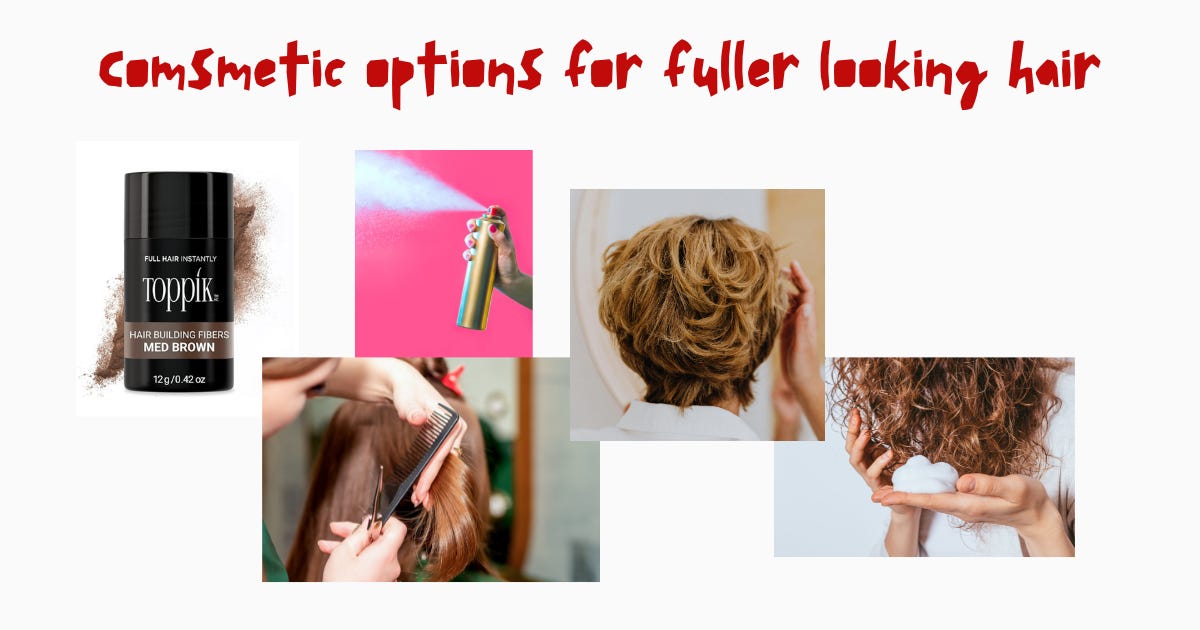
My favorite options were:
Get a volumninizing hair cut!
Lose some length, get your hairdresser to give you some layers/movement so your hair looks fluffy and full.
Use mousse or a root volumnizing product to make thin hair look thicker
Blow Dry using a round brush to give some volume
Use a hair fiber or scalp powder to cover up any scalp you can see
Wash your hair upside down in the shower
Blow dry your hair upside down
Tech
Ofcourse these days no list is complete without tech. There were some massagers, an infrared hair mask, and special shower heads that came with injectable serums.
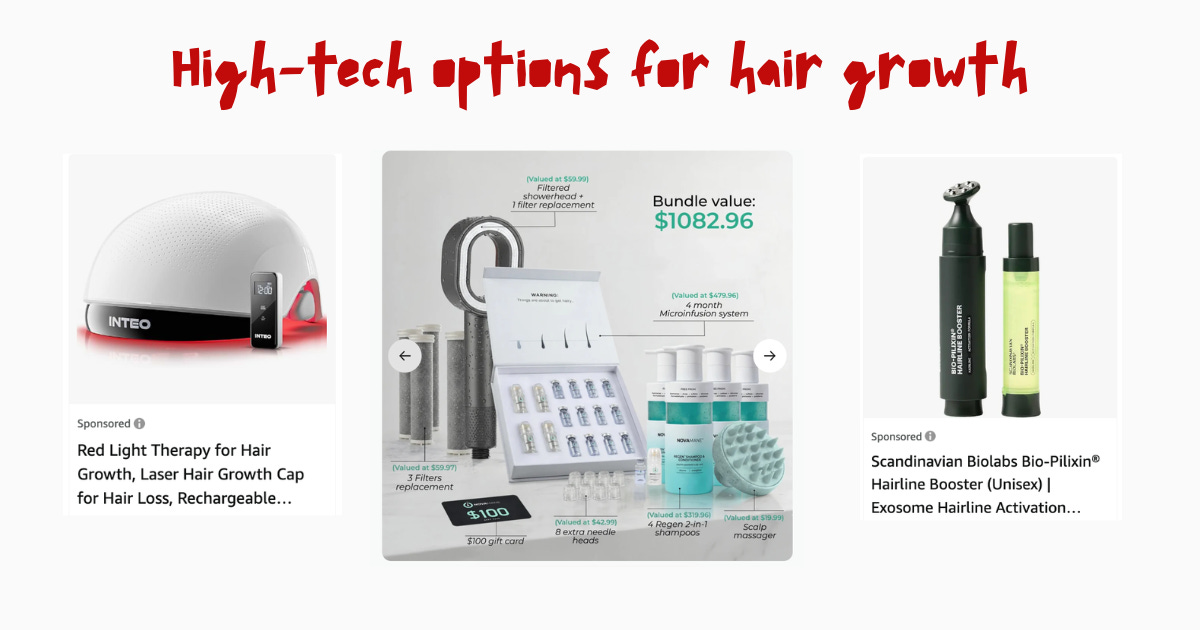
I don’t know how much I trust these. To each their own in this wild west version of the cosmetic industry.
My Take:
All I have to say is that I hear you. I know how scary it is to suddenly start losing hair (happened to me after a round of IVF). It feels way more emotional than I expected it to feel. I know we all love quick fixes, but this time - it might just be worth it to get it checked out by your doctor, make sure you treat root causes directly instead of falling into the trap of getting on a another subscription because these companies have learned how to use our fears and emotions to get us to take out that wallet and drop the money.
Have you tried any of these? Did any of them work for you? Want me to research something more deeply for you? Comment and let me know! And as always - thanks for reading <3 . If you haven’t subscribed yet - do it now!!
As promised - for my paid subscribers - Here’s the list of things you should track, the questions you should ask your doctor and how to get them to take you and your concerns seriously:
Little Snippet: