

From Calories to Chemistry: Why GLP-1s Require a High-Density Nutrition Strategy
The real key to success on GLP-1s isn’t less food - it’s better nutrition

For decades, weight loss was a game of volume: eat less, move more, and find ways to fight hunger. For those on GLP1s receptor agonists - like Ozempic, Wegovy, and Mounjaro - the era of big salads for every meal is over. These new drugs have rewritten the rules of weight loss.
The fight isn’t against hunger anymore - hunger signal has been shut off.
It is no longer behavioral; it is biochemical:
Traditionally, weight loss was treated as a series of choices (choosing a salad over a burger). Now, the choice is made for you at a molecular level. The medication mimics hormones that tell your brain and gut what to do, taking the “decision-making” out of your hands.
GLP1s do multiple things in your body at once:
Reshaping appetite through the brain: They work by attaching themselves to changing the brain’s reward system, quieting the “food noise” - the intrusive, constant thoughts about eating - so that food no longer feels like a dopamine-driven obsession.
Slowing digestion: This is the mechanical shift. By slowing down “gastric emptying,” the medication keeps food in your stomach longer. You aren’t just deciding to eat less; you physically cannot fit more in because the “exit door” of the stomach is moving at a fraction of its normal speed.
Recalibrating metabolism: Beyond just eating less, these tools change how your body handles blood sugar and insulin. It’s a systemic “reset” that shifts the body from a state of fat storage to a state where it can actually access and burn stored energy more efficiently.
Now, the problem has changed. It’s no longer about restricting intake - it’s about avoiding undernourishment in a body that physically won’t tolerate much food.
You still need adequate protein to preserve muscle, sufficient micronutrients to support metabolic function, and enough essential fats to maintain hormonal health. None of that adjusts just because your appetite disappeared.
The GLP-1 Paradox: Less Input, Same Requirement
GLP-1 medications create a clear contradiction: they sharply reduce how much you eat, but they do not reduce what your body requires.
Your body still runs on fixed biological needs. Your heart still needs electrolytes to function, your immune system still relies on nutrients like zinc and vitamin C, and your muscles and hormones still depend on a consistent supply of essential amino acids and healthy fats.
The paradox: The body you are feeding has not changed, even if your appetite has.
The Lost Signal: Why We Need “Mechanical Feeding”
We treat hunger as a nuisance, but biologically, it is a vital dashboard signal - a notification system for fuel, repair, and chemical balance.
The GLP-1 paradox is that it turns this warning light off. While the medication removes the friction of hunger, it does not remove the underlying biological needs.
You no longer feel hungry, but your cells still need the same resources as before. Because you can no longer rely on internal cues to tell you when or what to eat, you must replace instinct with strategy.
Thriving on a GLP-1 requires a shift from eating by "feeling" to eating by function. You must practice "mechanical feeding": delivering exactly what your biology dictates, on schedule, regardless of what your brain is (or isn't) asking for. Your appetite has changed, but your body’s requirements remain non-negotiable.
Nutritional Logistics 101
Think of your daily nutritional requirements as essential “cargo” - the protein, vitamins, and minerals your cells need every 24 hours.
Before GLP-1s: You had a large delivery truck (a 2,000+ calorie capacity) to bring in nutrients. You could fit in all the essentials (proteins, fats, carbs, minerals, vitamins and micronutrients) and also afford to pack filler nutrients - refined carbs and sugars - because there was plenty of extra space.
On GLP-1s: Your vehicle has been swapped for a compact car. Your capacity has plummeted to perhaps 1,200 calories, but the cargo list hasn’t changed.
If you fill this smaller space with the same percentage of filler as before, you will physically run out of room before the essentials are loaded.
On these medications, filler is no longer a harmless extra. Every calorie spent on low-density food is a missed opportunity to provide the chemistry your body needs, leading to a systemic “debt” that manifests as hair loss, muscle wasting, and chronic fatigue.
To prevent that, we are needed to find ways to provide all the nutrients your body needs in the smallest amount of volume.
From Volume to Value: The New Rules of Eating on GLP-1s
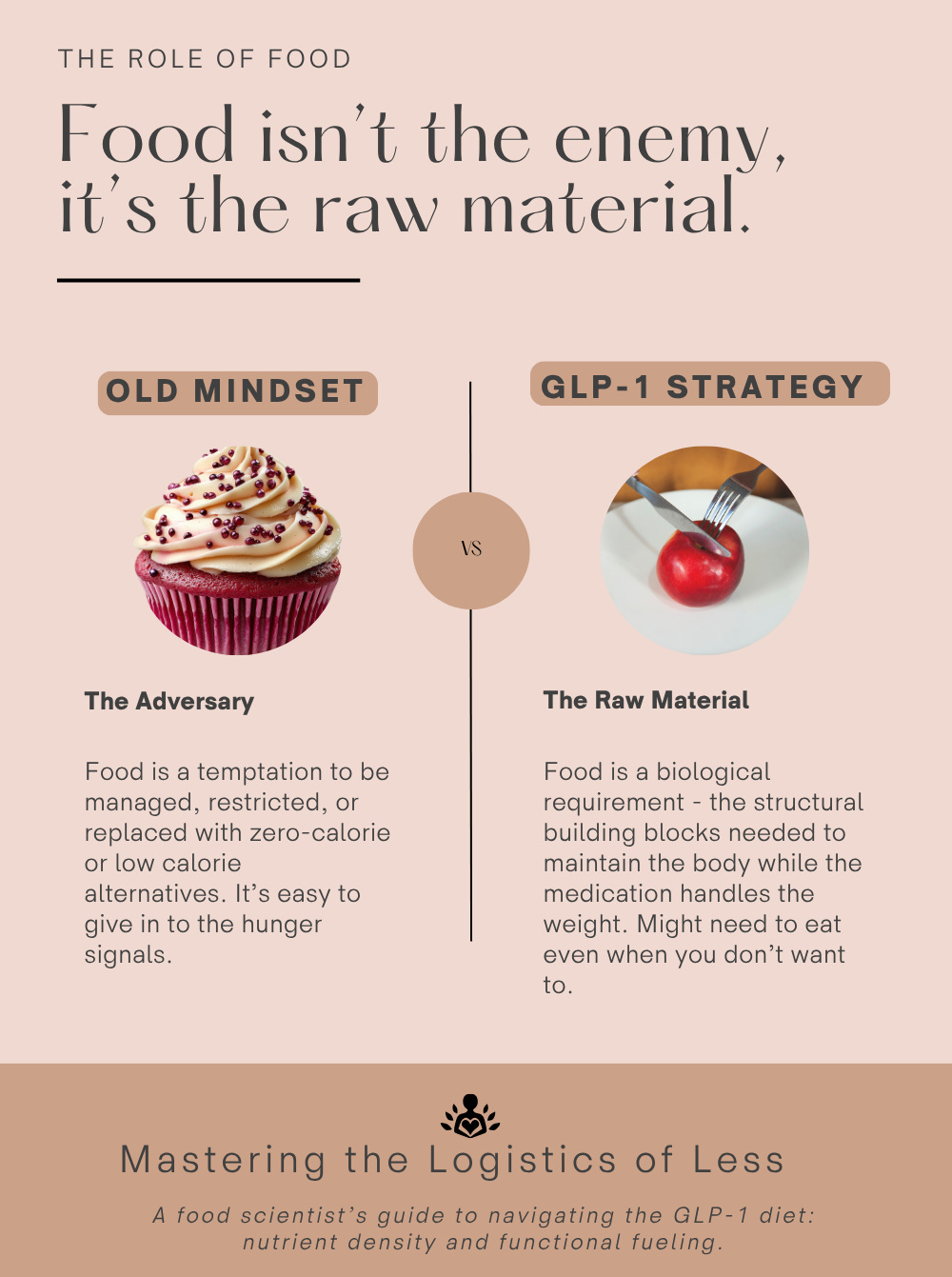
The “Density Over Volume” Cheat Sheet
If GLP-1s reduce how much you eat, the real question becomes: how do you make less food do more?
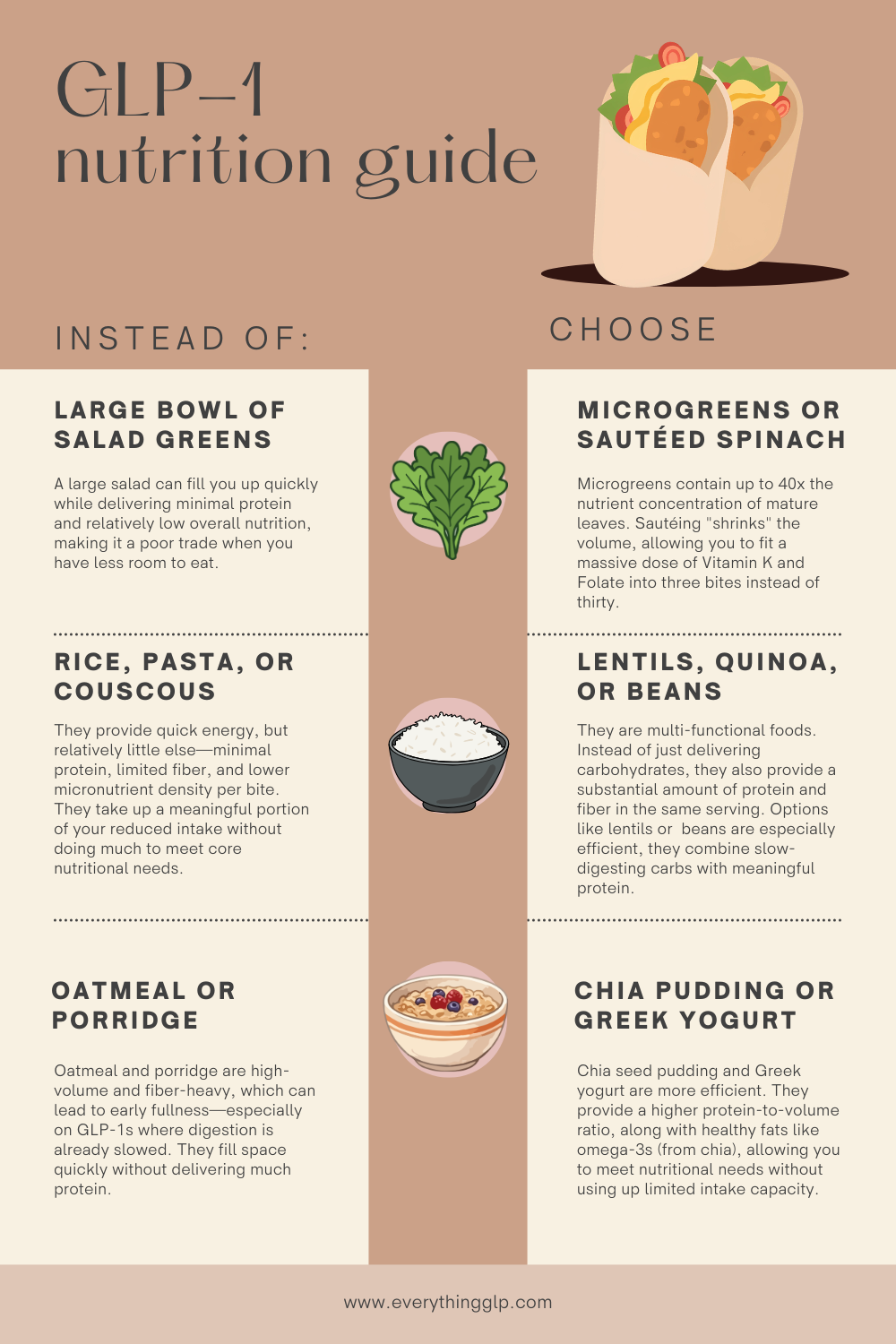
Success on these medications is no longer about how little you can eat. It’s about how effectively you can meet your body’s requirements within a much smaller intake window.
The goal is not just to lose weight. It’s to maintain function, preserve muscle, and support long-term metabolic health while the medication does its job.
Because on a GLP-1, the outcome isn’t determined by the drug alone—it’s determined by what you do with the space it creates.