

Can CoQ10 Fix My Eggs, My Energy, and My Existential Dread?
Why I started a CoQ10 supplement even though all the clinical data is... lukewarm

CoQ10. Co-enzyme Q10. A few weeks ago I had never heard of it, and this week I spent hours on the internet looking at $155 bottles of CoQ10 trying to decide which one to buy.
As a human who decided - in my “geriatric maternal age of 39 1/2 - to try for a baby - CoQ10 is something that fertility doctors are raving about, it’s being recommended for heart health and also hinting at “anti-aging” and longevity.
What’s real, what’s fake and what’s just an exaggeration?
So let’s find out why, what it means, who can use it, who should really consider it and how to avoid spending too much money on something that is … just marketing.
What is COQ10?
CoQ10 is an antioxidant that your body makes naturally.
A little note on antioxidants. We hear this word being thrown around a lot. What do they really do?
They are there to help protect your body from free-radicals - unstable molecules that damage your cells. Sound very abstract?
Visualize how antioxidants work:
Imagine that there is a classroom and the homework assignment is for every student to bring an orange to class (electron). If you don’t bring one you will fail your class so everyone is really on edge about this.
Most students remember to bring their oranges to class but there are a few bullies (free radicals) that don’t have an orange. They are unstable and angry - so they go on a rampage - just stealing an orange from the nearest student.
This creates a wave of chaos - The students who lost an orange are desperate - so they turn around and steal an orange from the student next to them - setting off a chain reaction of chaos - students running everywhere trying to steal each other’s oranges. (This situation is what we call oxidative stress)
Now this is where the antioxidants come in. Antioxidants have an orange tree and instead of just brining one orange to class, they bring a whole bushel of oranges. If a free radical needs one, they can give them one. By being able to give away an orange (electron) without being unstable, they help to balance out everyone, prevent chaos and help keep your system safe.
Back to CoQ10. It’s a fat soluble antioxidant present in nearly every cell of your entire body - and it works inside the mitochondria in your cells.
It’s main job is to help convert food-derived energy into ATP (the molecule your cells use as energy). It does this by transporting the electrons from one cell to another - helping the system move along and function smoothly.
This is why the supplement industry loves CoQ10. “Mitochondrial support” sounds scientific, futuristic, and conveniently vague. It lets a brand imply energy, aging, metabolism, brain function, fertility, heart health, and exercise performance without having to promise anything too specific.
So CoQ10 doesn’t give your body energy, it participates in energy production. And supplementation may help in contexts where the natural levels are low, demand is high or medical conditions make it relevant.
Why CoQ10 became a supplement celebrity
People take CoQ10 for a long list of reasons:
Heart health
Statin-associated muscle pain
Migraine prevention
Fertility and egg quality
Fatigue
Aging and longevity
Exercise performance
How many of these stand up to the research?
Heart health:
CoQ10 has proven evidence that it helps reduce the risks of some complications after heart failure (1), though it does not replace other medication. The rest of the claims around general prevention of heart disease and lowering blood pressure are still inconclusive.
Statin-associated muscle pain:
My mom takes statins, so I was very excited about something that could help her. The marketing of it sounds very real - statins reduce cholesterol by blocking the same pathway that is used in CoQ10 synthesis - so statins do reduce CoQ10 levels. When I first read about this, I was very excited. But sadly, it looks like the evidence for this is very mixed - A really well designed study (2) found that there was no benefit, while another study (3) found that there was a correlation and found that there was a benefit. My issue with this is that the second study here is a meta-analysis which means that they did not actually do any research themselves but compiled data from a bunch of different studies - which may have been smaller studies, different dosages, different types of statins, and had different study designs - so I am not really taking this one at face value.
It looks like leading foundations like NIH and The National Lipid Association treat this as a low-risk option that may or may not work in this case.
Considering the evidence, I was less excited about this as an option for my mom than when I first started researching this.
Migraine prevention:
The evidence that CoQ10 reduces migraine severity is poor, it is not a proven migraine cure but it may help with the frequency and duration in some people. Studies (4) and (5) showed that there was a correlation between CoQ10 and that it did reduce the frequency of migraines while other meta studies (6) did not see a significant reduction in Migraine severity - but noted that duration and frequency were reduced.
Based on this - there may be some benefit to choosing to take this supplement if you are suffering from migraines - reduced duration and frequency sound great to me! It’s low risk with a potentially high payoff - and it looks like the professionals agree. With Canadian Headache Society and the American headache society giving CoQ10 a strong recommendation for people who suffer from migraines.
Fertility and Egg Quality:
This is the whole reason I ended up looking into this. When it comes to fertility and IVF, it turns out that CoQ10 MAY improve results, but is not proven to “fix egg quality” or reverse any age-related fertility decline.
So when it comes to the research:
Strongest evidence: IVF/ diminished ovarian reserve
This study (7) found that women who took CoQ10 200mg, 3 times a day for 60 days before IVF had more retrieved oocytes, higher fertilization rates, and more high-quality embryos.
Weak evidence: Natural Conception
It makes sense that there is weak evidence here, it’s much harder to track results. So here, we have to go off vibes.
Now this is a very personal decision and I get why anyone would want to try everything possible to conceive. Personally, I am taking it for the next 3 months and hoping for the best. This feels like a low-risk high potential of reward situation.
Fatigue:
CoQ10 is so easy to market for fatigue - it helps the mitochondria make ATP and ATP= energy. So COQ10 should be = less fatigue.
But the problem is fatigue isn’t one thing. Sure, if the fatigue is because of this specific route, it would help. But fatigue is normally associated with a whole host of other things - poor sleep, under-nutrition, inflammation, chronic illness, thyroid issues, depression and so many other things.
I understand why major medical sources like Mayo Clinic is cautious about this. They do not frame it as a solution for tiredness.
My two cents: CoQ10 feels like a bandaid applied just anywhere on your body if you are taking it for tiredness. Finding the root cause and treating that would be so much more helpful!
Aging and longevity
I wish CoQ10 was the fountain of youth we were all told exists but sadly there is not enough evidence to support that. The logic makes sense - mitochondrial function declines with age → less CoQ10. So if you have more CoQ10 → reverse the effects of aging. Simple Right? Unfortunately, It’s not that simple. Our tissues seem to degrade at different rates, meaning a simple CoQ10 supplement will not fix it.
There was one study (8) that found that some biomarkers were improved in some older older adults… but it is important to note that all of the adults in this study had low selenium and were given both selenium and CoQ10. So while these results are promising, I wouldn’t spend my money on these expensive supplements for the sake of longevity unless it was prescribed by a doctor, for a specific purpose.
Exercise performance:
Again, not too much conclusive evidence. This study (9) only tested acute CoQ10 supplementation for 14 days in 22 trained and untrained individuals. Here they found that the supplementation did correlate to an increased time to treadmill exhaustion. This other study (10) found that CoQ10 did increase blood CoQ10 but found that any performance effects were small and inconsistent.
Unless you definitely have lowered CoQ10, I wouldn’t rely on this supplement to help you get better exercise performance.
TLDR on the supplement claims:
The strongest argument for CoQ10 is the story of what it does in your body and how it works. All scientists agree on that part. Where it becomes murky is the part where that mechanism is actually used by your body to provide the results you need.
Unless your doctor is prescribing you CoQ10 for a specific purpose - it is unlikely to have any major impact.
All the claims or implied benefits seem to come down the same pipeline:
Mitochondria makes energy → CoQ10 supports the mitochondria → CoQ10 therefore supports: healthy aging, exercise recovery, heart health etc. But this last part is where the chain breaks in most stories and claims.
It has some real value in migraine prevention, IVF related uses, and for heart failure/ surgery uses; but I wouldn’t go so far as to believe the broader wellness claims.
If you’ve decided that you still want to add CoQ10 to your supplement stack, here’s what you need to know.
Before you shop of CoQ10:
There are 2 formats of CoQ10 you will see when you are shopping for it: Ubiquinone and Ubiquinol.
Ubiquinone = the oxidized form of CoQ10
Ubiquinol = the reduced form of CoQ10
Your body converts these back and forth depending on what your body needs at that time, so both exist naturally in your body.
Ubiquinone: oxidized form
Ubiquinone is the electron-accepting form. In simplified terms:
Ubiquinone accepts electrons → becomes ubiquinol.
It is more chemically stable form of CoQ10. This format is usually cheaper, but absorption can be good if it is well formulated.
Ubiquinol: reduced form
Ubiquinol is the electron-rich form. In simplified terms:
Ubiquinol donates electrons → becomes ubiquinone.
Because it can donate electrons, ubiquinol is often described as the “active antioxidant” form. This format is usually more expensive.
Absorption: Which form is better?
CoQ10 in general is difficult to absorb because it is a large molecule that is fat-soluble. That means the body does not simply absorb whatever is listed on the front of the label. It has to dissolve into fat before it can move through the intestinal wall, which is why you will see it recommended to take it with a fatty meal. For this same reason, many supplements putting it together with omega-3 and this will help improve it’s absorption.
This study (11) found that ubiquinol raises blood CoQ10 levels more than ubiquinone whereas this one (12) found no significant difference in how both of these forms were absorbed.
The way that it is formulated plays a huge role in how easily it is absorbed by your body. This study (13) compared different formats of ubiquinone capsules to Ubiquinol capsules and even a water soluble CoQ10 syrup. The water-soluble formulation produced high bioavailability and performed similarly to ubiquinol in that study, while standard ubiquinone was lower.
So turns the right question to ask is: is this formulated well?
Shopping for CoQ10
Pure encapsulations
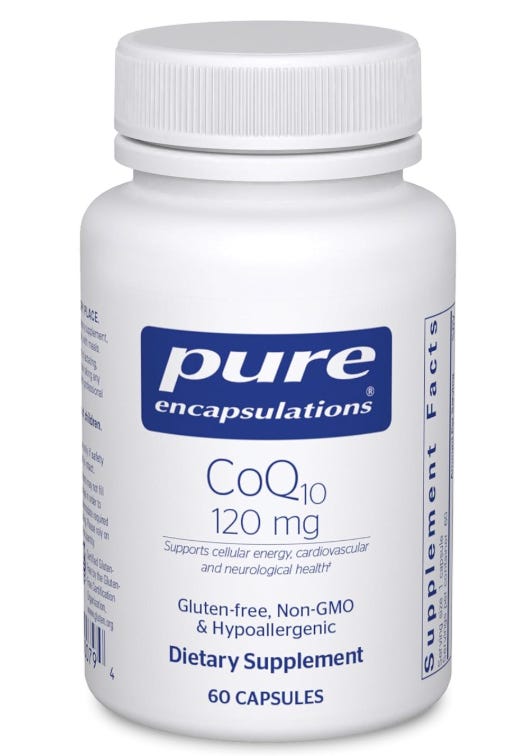
Firstly I want to start off by saying that Pure Encapsulations is a company that is owned by Nestle and I have many problems with Nestle and not trusting them after all the dirty things they’ve done in this industry. Anyway, coming to the actual product here itself, it is we don’t know whether it’s uviquinone or ubiquinol. It doesn’t say anything about it. In fact, on the supplement products label, it just says COQ10 and it is aKaneka Q ten, which is the gold standard for COQ ten in the US. Food is really expensive though, and I’m not sure why. Um it is completely like gluten-free, allergen-free and pure encapsulations really talks about that. about that, where they’re just trying to be like the most neutral that they can possibly be. And if you have a lot of allergies and restrictions, then I would take a look at these as options. If not, I’m going to give this one a big fat pass.
Sometimes, it’s just the price we pay for peace of mind.
Sure the clinical data isn’t robust but if we are paying for hope - it might just be worth it.
Research:
Mortensen, S, Rosenfeldt, F, Kumar, A. et al. The Effect of Coenzyme Q10 on Morbidity and Mortality in Chronic Heart Failure: Results From Q-SYMBIO: A Randomized Double-Blind Trial. J Am Coll Cardiol HF. 2014 Dec, 2 (6) 641–649.
https://doi.org/10.1016/j.jchf.2014.06.008
Taylor B, Lorson L, White C ...
A randomized trial of coenzyme Q10 in patients with confirmed Statin Myopathy
Atherosclerosis, 2014; 238, 329-335
https://www.atherosclerosis-journal.com/article/S0021-9150%2814%2901636-0
Qu, H., Guo, M., Chai, H., Wang, W. T., Gao, Z. Y., & Shi, D. Z. (2018). Effects of coenzyme Q10 on statin-induced myopathy: An updated meta-analysis of randomized controlled trials. Journal of the American Heart Association, 7(19), e009835. https://doi.org/10.1161/JAHA.118.009835
Rozen TD, Oshinsky ML, Gebeline CA, Bradley KC, Young WB, Shechter AL, Silberstein SD. Open label trial of coenzyme Q10 as a migraine preventive. Cephalalgia. 2002 Mar;22(2):137-41. doi: 10.1046/j.1468-2982.2002.00335.x. PMID: 11972582.
https://pubmed.ncbi.nlm.nih.gov/11972582/
Sándor, P. S., Di Clemente, L., Coppola, G., Saenger, U., Fumal, A., Magis, D., Seidel, L., Agosti, R. M., & Schoenen, J. (2005). Efficacy of coenzyme Q10 in migraine prophylaxis: A randomized controlled trial. Neurology, 64(4), 713–715. https://doi.org/10.1212/01.WNL.0000151975.03598.ED
Sazali S, Badrin S, Norhayati MN, Idris NS. Coenzyme Q10 supplementation for prophylaxis in adult patients with migraine-a meta-analysis. BMJ Open. 2021 Jan 5;11(1):e039358. doi: 10.1136/bmjopen-2020-039358. PMID: 33402403; PMCID: PMC7786797.
Xu Y, Nisenblat V, Lu C, Li R, Qiao J, Zhen X, Wang S. Pretreatment with coenzyme Q10 improves ovarian response and embryo quality in low-prognosis young women with decreased ovarian reserve: a randomized controlled trial. Reprod Biol Endocrinol. 2018 Mar 27;16(1):29. doi: 10.1186/s12958-018-0343-0. PMID: 29587861; PMCID: PMC5870379.
https://pmc.ncbi.nlm.nih.gov/articles/PMC5870379
Alehagen U, Alexander J, Aaseth JO, Larsson A, Svensson E, Opstad TB. Effects of an Intervention with Selenium and Coenzyme Q10 on Five Selected Age-Related Biomarkers in Elderly Swedes Low in Selenium: Results That Point to an Anti-Ageing Effect-A Sub-Analysis of a Previous Prospective Double-Blind Placebo-Controlled Randomised Clinical Trial. Cells. 2023 Jul 4;12(13):1773. doi: 10.3390/cells12131773. PMID: 37443807; PMCID: PMC10340529.
Cooke M, Iosia M, Buford T, Shelmadine B, Hudson G, Kerksick C, Rasmussen C, Greenwood M, Leutholtz B, Willoughby D, Kreider R. Effects of acute and 14-day coenzyme Q10 supplementation on exercise performance in both trained and untrained individuals. J Int Soc Sports Nutr. 2008 Mar 4;5:8. doi: 10.1186/1550-2783-5-8. PMID: 18318910; PMCID: PMC2315638.
Deng H, Song T, Yin M, Xu K, Zhong Y, Mohd NB, Naharudin MNB, Yusof A, Fan X. Coenzyme Q10 supplementation increases blood concentrations but shows limited and inconsistent effects on exercise performance: a systematic review and meta-analysis. Br J Nutr. 2025 Dec 29:1-21. doi: 10.1017/S0007114525106211. Epub ahead of print. PMID: 41457257.
Langsjoen PH, Langsjoen AM. Comparison study of plasma coenzyme Q10 levels in healthy subjects supplemented with ubiquinol versus ubiquinone. Clin Pharmacol Drug Dev. 2014 Jan;3(1):13-7. doi: 10.1002/cpdd.73. Epub 2013 Oct 8. PMID: 27128225.
Mantle D, Dybring A. Bioavailability of Coenzyme Q10: An Overview of the Absorption Process and Subsequent Metabolism. Antioxidants (Basel). 2020 May 5;9(5):386. doi: 10.3390/antiox9050386. PMID: 32380795; PMCID: PMC7278738.
Pravst I, Rodríguez Aguilera JC, Cortes Rodriguez AB, Jazbar J, Locatelli I, Hristov H, Žmitek K. Comparative Bioavailability of Different Coenzyme Q10 Formulations in Healthy Elderly Individuals. Nutrients. 2020 Mar 16;12(3):784. doi: 10.3390/nu12030784. PMID: 32188111; PMCID: PMC7146408.